Waterdown highschool teacher Nathan Tidridge has published a book on Canada's relationship with the Crown called Canada's Constitutional Monarchy. Mr. Tidridge wrote the text in response to the lack of accurate resources on the role of the monarchy in our country.
The book is available at Pickwick Books in Waterdown. Read the article featured in the Flamborough Review here.
Access his website http://www.canadiancrown.com/ to find information which compliments the book. You will find information on the author, additional interesting details about the Canadian Crown.
Sunday, November 20, 2011

Waterdown's Own Gord Anderson has Book Published on War of 1812
Gord Anderson, an accountant from Waterdown, Ontario, has published a book called Beyond the Great War. The book, a historical fiction based on facts, is a novel for teens and highschool readers about the War of 1812.
You can purchase the book at Pickwick Books in Waterdown Ontario. Read the recent article in the Flamborough Review here.
You can purchase the book at Pickwick Books in Waterdown Ontario. Read the recent article in the Flamborough Review here.
Saturday, November 19, 2011
New Online Resource for Literacy

Once registered, students can write simple stories with the help of an adult where they become the main character. Another part I love is that once the stories have been written they can be uploaded to the parent's Facebook account to share their child's story with all of their friends.
Check it out in the Resources section!
Wednesday, November 16, 2011
Best Practices for Silent Reading: An Article Summary
In 2000, the National Reading Panel published a report in an effort to identify "effective instructional reading approaches" and determine "their readiness for application in the classroom" (Report of the National Reading Panel, 2000). As part of their research, the panel sought to answer the question: "Do programs that increase the amount of children’s independent reading [such as D.E.A.R.] improve reading achievement and motivation?" (Report of the National Reading Panel, 2000).
Despite the extensive use of independent reading practices in schools across North America (Report of the National Reading Panel, 2000) the panel could not find any evidence to suggest that independent silent reading in isolation reliably improves reading achievement or reading skills.
At the same time, there is also no evidence to suggest that time set aside for silent reading should be eliminated from instructional time altogether. In a recent article by called Reconsidering Silent Reading (featured on LD Online, 2011), the author encourages educators to revisit silent reading programs and consider how they are both implemented, and supplemented with other activities, to increase their value to student reading achievement.
Outlined in the article are some important classroom conditions taken from the book Revisiting Silent Reading: New Directions for Teachers and Researchers by Hiebert and Reutzel (2010) that will improve the practice of silent reading in classrooms. Their suggestions include:
Students should be engaged in silent reading and remain on-task. Students should understand that silent reading time is time to practice their reading skills. Over time, students should be working to increase their capacity to remain in silent reading tasks for longer durations, and should be actively working to improve specific reading skills.
Ensure students are held accountable for what they are reading and understanding. Students should be held accountable for the time spent in silent reading activities. The method of accountability should be quick, easy, and straight forward, and can even provide evidence of whether or not certain skills, such as stamina, are improving.
Silent Reading Programs should include time for interaction and feedback. Conversations and interactions between students, and between student and teacher should be encouraged, planned for, and supported. While modelling good reading habits is important, engaging in DEAR at the same as your students may not be time well spent. Engaging students in conversation about what they are reading may better support their developing reading skills.
For more information on how to support your students in your silent reading program, consider becoming familiar with Reutzel, Jones and Newman Scaffolded Silent Reading approach (2010). See Exploring Scaffolded Silent Reading, or Scaffolded Silent Reading, or this search results page.
____________________________________
The report published by the National Reading
Panel was an evidence-based assessment of
the scientific research literature on Reading
and it's implications for reading instruction.
____________________________________
____________________________________
Despite the extensive use of independent reading practices in schools across North America (Report of the National Reading Panel, 2000) the panel could not find any evidence to suggest that independent silent reading in isolation reliably improves reading achievement or reading skills.
At the same time, there is also no evidence to suggest that time set aside for silent reading should be eliminated from instructional time altogether. In a recent article by called Reconsidering Silent Reading (featured on LD Online, 2011), the author encourages educators to revisit silent reading programs and consider how they are both implemented, and supplemented with other activities, to increase their value to student reading achievement.
Outlined in the article are some important classroom conditions taken from the book Revisiting Silent Reading: New Directions for Teachers and Researchers
by Hiebert and Reutzel (2010) that will improve the practice of silent reading in classrooms. Their suggestions include:- Allow students to select their own reading material.
- Students should be engaged in silent reading and remain on-task.
- Ensure students are held accountable for what they are reading and understanding.
- Silent Reading Programs should include time for interaction and feedback.
Students should be engaged in silent reading and remain on-task. Students should understand that silent reading time is time to practice their reading skills. Over time, students should be working to increase their capacity to remain in silent reading tasks for longer durations, and should be actively working to improve specific reading skills.
Ensure students are held accountable for what they are reading and understanding. Students should be held accountable for the time spent in silent reading activities. The method of accountability should be quick, easy, and straight forward, and can even provide evidence of whether or not certain skills, such as stamina, are improving.
Silent Reading Programs should include time for interaction and feedback. Conversations and interactions between students, and between student and teacher should be encouraged, planned for, and supported. While modelling good reading habits is important, engaging in DEAR at the same as your students may not be time well spent. Engaging students in conversation about what they are reading may better support their developing reading skills.
For more information on how to support your students in your silent reading program, consider becoming familiar with Reutzel, Jones and Newman Scaffolded Silent Reading approach (2010). See Exploring Scaffolded Silent Reading, or Scaffolded Silent Reading, or this search results page.
____________________________________
Wednesday, September 14, 2011
Helping Students Be Better Listeners
You've just finished explaining an activity to the students only to have student after student interrupt your conference meetings with other students asking what they are supposed to do. Does this sound familiar?
Wednesday, August 24, 2011
Preparing for Parent/Teacher Meetings: Getting Everyone On the Same Page

Whether a parent or a teacher, chances are that you have been called in for a meeting or two.
People often view meetings as an indicator that something is changing or that there is a problem that needs to be addressed. This can result in the perception that something is "wrong" causing people to walk in to a meeting feeling anxious. Couple this with an intimidating list of people attending such as administrators and specialists, it's easy to walk into a meeting defensive or even hostile.

Obviously, this can interfere with the productivity of the meeting, and cause for parent/teacher, teacher/teacher, or teacher/administrator relationships to begin to break down.

Finding out the specific purpose of the meeting can help to alleviate anxiety and allow everyone to be appropriately prepared, but I came across a great tool recently that helps to make sure that everyone present at a meeting enters the meeting prepared and on the same page.
The tool is a chart that identifies information that can be gathered prior to the meeting by everyone attending. It serves to get everyone on the same page and highlights discrepencies which can then be addressed. The chart leaves room to jot down notes on the following issues: - Concerns
- Outcomes
- Roles
- Needs
- Expectations
- Resources
- Skills
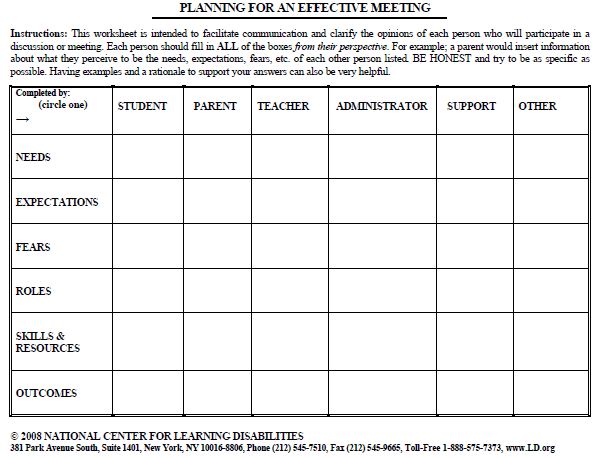
I remember the points I need to gather information on with this with the acronym CORNERS. This works well because by understanding another's ideas about what concerns them most, what they hope the outcome of the meeting will be, what they percieve their role to be, etc., essentially puts you in their corner. Of course, it is also important that you explore and communicate your own CORNERS so that you can address areas causing you concern.
Ways to Use the Meeting Chart Tool
This information can be shared a number of formal and informal ways prior to meeting. To be most effective, LD.org recommends that each person writes their own views for each CORNERS issue, but then also fills out what they percieve as being other's CORNERS. Don't forget to have the student also fill out a meeting chart of their own so that they can have their voice heard even if they are not present for the actual meeting.
Another use of the chart would be to have each person attending fill out the chart in the designated column, and pass it along to the next person who does the same. The finished chart will have each person relating their own needs and expectations and if a finished copy is supplied to each person then everyone will go into the meeting knowing what each wants to get from the meeting and what their frame of mind is. It is important that all attendees are comfortable with this process, as some people will feel more comfortable knowing their sheet is being returned only to the classroom teacher or administrator rather than all attendees.
If such a formal written account of CORNERS is not necessary, the information can be gathered informally with a quick phone call, email, or face-to-face encounter at pick-up or drop-off times. Teachers can ask parents what their greatest concern is with regards to the meeting, what they hope the outcome of the meeting will be, and what they need from you to realize that goal. Parents will likely appreciate having their feelings and concerns heard and will help to put them at ease. Parents, too, can ask teachers very similar questions allowing them to gain important information and perspective.
If you don't choose to distribute the chart to everyone prior to the meeting, bring a copy into the meeting anyway. This chart can be brought to the meeting and filled in as the meeting progresses. If the meeting stalls or if it begins to go in an unproductive direction, refer to your chart. Gapping holes in the chart may prompt you to ask certain questions that will help the meeting get back on track and help everyone feel heard.
A copy of a Meeting Chart is available through this link: MeetingChart.pdf
The chart begins by asking about needs first. This is a good place to start because it shifts thinking away from being defensive or being on the attack, to thinking about what their needs are and how they can be met. It sets the focus as the rest of the chart is filled out, and hopefully sets the tone of the meeting that will follow.
I have altered the chart to suit my own needs, and it is pictured below. If you would prefer copies of this alternate Meeting Chart, post a request at the end of post or contact me directly (see the About Me section) and I would be happy to send you a copy via email as an attachment. If you are a a Techie and you know how I would go about uploading the pdf version to this website please let me know! I have a pdf version saved, but I don't know how to upload it as link for visitors to download.

Here is a different version of the Meeting Chart that I use for smaller meetings with just the student, or the parents.

Thursday, July 28, 2011
Getting a Large White Board on the Cheap
I know it is not even August yet, and even though I won't be finding myself in a classroom of my own this fall, I can't help but begin to think about Classroom organization and setup. It's like the migration of the robin every fall... I can't help it!
I loved using white boards in my classroom when I was teaching. I found they were cleaner than using a chalkboard, and liked being able to use markers of several different colours.
But I also remember how crazy-expensive large white boards can be. It was difficult to find the budget for them. Had I known that I could have made a white board for a fraction of the cost, I would have done it in a heartbeat... even though I am not overly handy!
I haven't tried it myself, but it looks quite easy and straight-forward. According to this website a large board can be made for under $20. That would likely retail anywhere from $150 to $200 easily.
Here's the link:
How To Make a Wall-sized White Board for Cheap
I loved using white boards in my classroom when I was teaching. I found they were cleaner than using a chalkboard, and liked being able to use markers of several different colours.
But I also remember how crazy-expensive large white boards can be. It was difficult to find the budget for them. Had I known that I could have made a white board for a fraction of the cost, I would have done it in a heartbeat... even though I am not overly handy!
I haven't tried it myself, but it looks quite easy and straight-forward. According to this website a large board can be made for under $20. That would likely retail anywhere from $150 to $200 easily.
Here's the link:
How To Make a Wall-sized White Board for Cheap
Subscribe to:
Posts (Atom)