I just added a new resource which is now featured in the resource section of this website under "Online Literacy". It is a link to a website called The Power Of Reading.
Once registered, students can write simple stories with the help of an adult where they become the main character. Another part I love is that once the stories have been written they can be uploaded to the parent's Facebook account to share their child's story with all of their friends.
Check it out in the Resources section!
Educational Resources and Inspiration for Parents, Students and Teachers.
Saturday, November 19, 2011
Wednesday, November 16, 2011
Best Practices for Silent Reading: An Article Summary
In 2000, the National Reading Panel published a report in an effort to identify "effective instructional reading approaches" and determine "their readiness for application in the classroom" (Report of the National Reading Panel, 2000). As part of their research, the panel sought to answer the question: "Do programs that increase the amount of children’s independent reading [such as D.E.A.R.] improve reading achievement and motivation?" (Report of the National Reading Panel, 2000).
Despite the extensive use of independent reading practices in schools across North America (Report of the National Reading Panel, 2000) the panel could not find any evidence to suggest that independent silent reading in isolation reliably improves reading achievement or reading skills.
At the same time, there is also no evidence to suggest that time set aside for silent reading should be eliminated from instructional time altogether. In a recent article by called Reconsidering Silent Reading (featured on LD Online, 2011), the author encourages educators to revisit silent reading programs and consider how they are both implemented, and supplemented with other activities, to increase their value to student reading achievement.
Outlined in the article are some important classroom conditions taken from the book Revisiting Silent Reading: New Directions for Teachers and Researchers
by Hiebert and Reutzel (2010) that will improve the practice of silent reading in classrooms. Their suggestions include:
Students should be engaged in silent reading and remain on-task. Students should understand that silent reading time is time to practice their reading skills. Over time, students should be working to increase their capacity to remain in silent reading tasks for longer durations, and should be actively working to improve specific reading skills.
Ensure students are held accountable for what they are reading and understanding. Students should be held accountable for the time spent in silent reading activities. The method of accountability should be quick, easy, and straight forward, and can even provide evidence of whether or not certain skills, such as stamina, are improving.
Silent Reading Programs should include time for interaction and feedback. Conversations and interactions between students, and between student and teacher should be encouraged, planned for, and supported. While modelling good reading habits is important, engaging in DEAR at the same as your students may not be time well spent. Engaging students in conversation about what they are reading may better support their developing reading skills.
For more information on how to support your students in your silent reading program, consider becoming familiar with Reutzel, Jones and Newman Scaffolded Silent Reading approach (2010). See Exploring Scaffolded Silent Reading, or Scaffolded Silent Reading, or this search results page.
____________________________________
The report published by the National Reading
Panel was an evidence-based assessment of
the scientific research literature on Reading
and it's implications for reading instruction.
____________________________________
____________________________________
Despite the extensive use of independent reading practices in schools across North America (Report of the National Reading Panel, 2000) the panel could not find any evidence to suggest that independent silent reading in isolation reliably improves reading achievement or reading skills.
At the same time, there is also no evidence to suggest that time set aside for silent reading should be eliminated from instructional time altogether. In a recent article by called Reconsidering Silent Reading (featured on LD Online, 2011), the author encourages educators to revisit silent reading programs and consider how they are both implemented, and supplemented with other activities, to increase their value to student reading achievement.
Outlined in the article are some important classroom conditions taken from the book Revisiting Silent Reading: New Directions for Teachers and Researchers
- Allow students to select their own reading material.
- Students should be engaged in silent reading and remain on-task.
- Ensure students are held accountable for what they are reading and understanding.
- Silent Reading Programs should include time for interaction and feedback.
Students should be engaged in silent reading and remain on-task. Students should understand that silent reading time is time to practice their reading skills. Over time, students should be working to increase their capacity to remain in silent reading tasks for longer durations, and should be actively working to improve specific reading skills.
Ensure students are held accountable for what they are reading and understanding. Students should be held accountable for the time spent in silent reading activities. The method of accountability should be quick, easy, and straight forward, and can even provide evidence of whether or not certain skills, such as stamina, are improving.
Silent Reading Programs should include time for interaction and feedback. Conversations and interactions between students, and between student and teacher should be encouraged, planned for, and supported. While modelling good reading habits is important, engaging in DEAR at the same as your students may not be time well spent. Engaging students in conversation about what they are reading may better support their developing reading skills.
For more information on how to support your students in your silent reading program, consider becoming familiar with Reutzel, Jones and Newman Scaffolded Silent Reading approach (2010). See Exploring Scaffolded Silent Reading, or Scaffolded Silent Reading, or this search results page.
____________________________________
Wednesday, September 14, 2011
Helping Students Be Better Listeners
You've just finished explaining an activity to the students only to have student after student interrupt your conference meetings with other students asking what they are supposed to do. Does this sound familiar?
Wednesday, August 24, 2011
Preparing for Parent/Teacher Meetings: Getting Everyone On the Same Page
Whether a parent or a teacher, chances are that you have been called in for a meeting or two.
People often view meetings as an indicator that something is changing or that there is a problem that needs to be addressed. This can result in the perception that something is "wrong" causing people to walk in to a meeting feeling anxious. Couple this with an intimidating list of people attending such as administrators and specialists, it's easy to walk into a meeting defensive or even hostile.
Obviously, this can interfere with the productivity of the meeting, and cause for parent/teacher, teacher/teacher, or teacher/administrator relationships to begin to break down.
Finding out the specific purpose of the meeting can help to alleviate anxiety and allow everyone to be appropriately prepared, but I came across a great tool recently that helps to make sure that everyone present at a meeting enters the meeting prepared and on the same page.
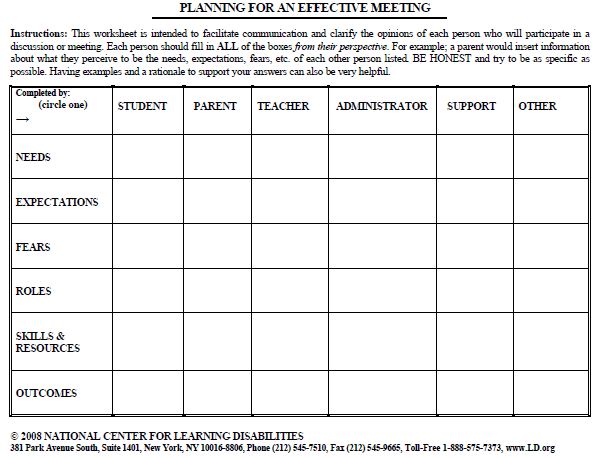
The tool is a chart that identifies information that can be gathered prior to the meeting by everyone attending. It serves to get everyone on the same page and highlights discrepencies which can then be addressed. The chart leaves room to jot down notes on the following issues: - Concerns
- Outcomes
- Roles
- Needs
- Expectations
- Resources
- Skills
I remember the points I need to gather information on with this with the acronym CORNERS. This works well because by understanding another's ideas about what concerns them most, what they hope the outcome of the meeting will be, what they percieve their role to be, etc., essentially puts you in their corner. Of course, it is also important that you explore and communicate your own CORNERS so that you can address areas causing you concern.
Ways to Use the Meeting Chart Tool
This information can be shared a number of formal and informal ways prior to meeting. To be most effective, LD.org recommends that each person writes their own views for each CORNERS issue, but then also fills out what they percieve as being other's CORNERS. Don't forget to have the student also fill out a meeting chart of their own so that they can have their voice heard even if they are not present for the actual meeting.
Another use of the chart would be to have each person attending fill out the chart in the designated column, and pass it along to the next person who does the same. The finished chart will have each person relating their own needs and expectations and if a finished copy is supplied to each person then everyone will go into the meeting knowing what each wants to get from the meeting and what their frame of mind is. It is important that all attendees are comfortable with this process, as some people will feel more comfortable knowing their sheet is being returned only to the classroom teacher or administrator rather than all attendees.
If such a formal written account of CORNERS is not necessary, the information can be gathered informally with a quick phone call, email, or face-to-face encounter at pick-up or drop-off times. Teachers can ask parents what their greatest concern is with regards to the meeting, what they hope the outcome of the meeting will be, and what they need from you to realize that goal. Parents will likely appreciate having their feelings and concerns heard and will help to put them at ease. Parents, too, can ask teachers very similar questions allowing them to gain important information and perspective.
If you don't choose to distribute the chart to everyone prior to the meeting, bring a copy into the meeting anyway. This chart can be brought to the meeting and filled in as the meeting progresses. If the meeting stalls or if it begins to go in an unproductive direction, refer to your chart. Gapping holes in the chart may prompt you to ask certain questions that will help the meeting get back on track and help everyone feel heard.
A copy of a Meeting Chart is available through this link: MeetingChart.pdf
The chart begins by asking about needs first. This is a good place to start because it shifts thinking away from being defensive or being on the attack, to thinking about what their needs are and how they can be met. It sets the focus as the rest of the chart is filled out, and hopefully sets the tone of the meeting that will follow.
I have altered the chart to suit my own needs, and it is pictured below. If you would prefer copies of this alternate Meeting Chart, post a request at the end of post or contact me directly (see the About Me section) and I would be happy to send you a copy via email as an attachment. If you are a a Techie and you know how I would go about uploading the pdf version to this website please let me know! I have a pdf version saved, but I don't know how to upload it as link for visitors to download.
Here is a different version of the Meeting Chart that I use for smaller meetings with just the student, or the parents.
Thursday, July 28, 2011
Getting a Large White Board on the Cheap
I know it is not even August yet, and even though I won't be finding myself in a classroom of my own this fall, I can't help but begin to think about Classroom organization and setup. It's like the migration of the robin every fall... I can't help it!
I loved using white boards in my classroom when I was teaching. I found they were cleaner than using a chalkboard, and liked being able to use markers of several different colours.
But I also remember how crazy-expensive large white boards can be. It was difficult to find the budget for them. Had I known that I could have made a white board for a fraction of the cost, I would have done it in a heartbeat... even though I am not overly handy!
I haven't tried it myself, but it looks quite easy and straight-forward. According to this website a large board can be made for under $20. That would likely retail anywhere from $150 to $200 easily.
Here's the link:
How To Make a Wall-sized White Board for Cheap
I loved using white boards in my classroom when I was teaching. I found they were cleaner than using a chalkboard, and liked being able to use markers of several different colours.
But I also remember how crazy-expensive large white boards can be. It was difficult to find the budget for them. Had I known that I could have made a white board for a fraction of the cost, I would have done it in a heartbeat... even though I am not overly handy!
I haven't tried it myself, but it looks quite easy and straight-forward. According to this website a large board can be made for under $20. That would likely retail anywhere from $150 to $200 easily.
Here's the link:
How To Make a Wall-sized White Board for Cheap
Tuesday, July 19, 2011
Commonly Misspelled Words - And How to Spell Them Correctly
I often look up the proper spelling of words while online, and sometimes I stumble across sites about some of the most commonly misspelled words in the English language. I came across another one recently, but this one is a little different.
Not only does it list the words most likely to give your students trouble, it also gives mnemonic devices and other tricks to help them remember the proper spelling.
The site is appropriate for grade 7/8, but would also serve students in high school very well also, and could give teachers vocabulary ideas.
The website can be found at 100 Most Often Misspelled Words. The link has also been included in the Resources section of this website.
Happy Spelling!
Not only does it list the words most likely to give your students trouble, it also gives mnemonic devices and other tricks to help them remember the proper spelling.
The site is appropriate for grade 7/8, but would also serve students in high school very well also, and could give teachers vocabulary ideas.
The website can be found at 100 Most Often Misspelled Words. The link has also been included in the Resources section of this website.
Happy Spelling!
Thursday, July 14, 2011
Encouraging Families to Read Together with Family Literacy Bags
Family Literacy Bags are great for encouraging families to spend time reading together. The bags contain books and activities on a common theme or topic that children and their families can enjoy.
Teachers can assemble the bags and send them home with students for a period of time, or parents can assemble the bags themselves and enjoy the books and activities as a family.
The Family Literacy Bags were developed by Reading Rockets and are designed to encourage hands-on fun and learning. They have developed 10 bags that can be assembled quite quickly and easily by printing off the Activity Sheets and placing them in a large ziplock bag. The books themselves can also be included in the bag. Titles were specifically chosen because they are widely available in school and public libraries.
The Family Literacy Bags available from Reading Rockets are completely free, and can be assembled quickly and easily. Simply click on the Family Literacy Bag link, choose the topic that you would like to have your kit centered around, print it off, and borrow the books from your local public library. The bags are appropriate for pre-K to about grade 2.
Family Literacy Bags include:
What Happens Next? Level PreK-K. Explore what happens in The Very Hungry Caterpillar. The list of suggested books includes nonfiction titles about caterpillars and butterflies and fiction books that emphasize concepts such as counting, days of the week, or how things happen in sequence. When assembling your Very Hungry Caterpillar Activity packet to send home, simply include a copy of The Very Hungry Caterpillar and one of the nonfiction or concept books suggested. While designed as a school-to-home project, the Reading Rockets Literacy Bags are also great for summer programs, after-school programs, and home-schoolers. Download PDF.
Explore Your 5 Senses. Level K. The featured books for the Explore Your 5 Senses Literacy Bag are Green Eggs and Ham, by Dr. Seuss, and Me and My Senses, by Joan Sweeney. In the Seuss classic Green Eggs and Ham, Sam-I-Am is ever so persistent in trying to convince you that green eggs and ham really are delicious! In the nonfiction book Me and My Senses, the author introduces children to the five senses and how they work independently and together. While designed as a school-to-home project, the Reading Rockets Literacy Bags are also great for summer programs, after-school programs, and home-schoolers. Download PDF.
Explore the Ocean. Level Grade 1. The featured books are Flotsam by David Wiesner and The Magic School Bus on the Ocean Floor by Joanna Cole, illustrated by Bruce Degen. Flotsam, the beautifully illustrated wordless picture book that won the 2007 Caldecott Medal, reveals the secrets held in a wave-battered underwater camera found on the beach by a young boy. After the boy has the camera's film developed, imaginations are put to work as the reader views photographs of a curious world under the sea. In The Magic School Bus on the Ocean Floor, readers also get an unusual look at what's beneath the ocean's waves as Ms. Frizzle and her students take an exciting field trip to explore the animal and plant life of the ocean. The book also discusses tides, waves, and ocean topography. Download PDF.
Teachers can assemble the bags and send them home with students for a period of time, or parents can assemble the bags themselves and enjoy the books and activities as a family.
The Family Literacy Bags were developed by Reading Rockets and are designed to encourage hands-on fun and learning. They have developed 10 bags that can be assembled quite quickly and easily by printing off the Activity Sheets and placing them in a large ziplock bag. The books themselves can also be included in the bag. Titles were specifically chosen because they are widely available in school and public libraries.
The Family Literacy Bags available from Reading Rockets are completely free, and can be assembled quickly and easily. Simply click on the Family Literacy Bag link, choose the topic that you would like to have your kit centered around, print it off, and borrow the books from your local public library. The bags are appropriate for pre-K to about grade 2.
Family Literacy Bags include:
- Parent Information Sheet
- 1 Fiction and 1 Non-Fiction Book title on a common topic.
- Creativity Activity (hands-on craft)
- Imagination Activity (involving imaginative play, writing, or drawing)
- Get Real Activity (real-world experiences)
- Bookmark
Check out these wonderful Family Literacy Bags for yourself:
Explore Snow. Level K. The featured books for the Explore Snow Literacy Bag are The Snowy Day, written and illustrated by Ezra Jack Keats, and Snow Is Falling, written by Franklyn Branley and illustrated by Holly Keller. The Snowy Day, winner of the 1963 Caldecott Medal, tells the story of a young boy who wakes up to discover that a beautiful blanket of snow has fallen during the night. Snow Is Falling explores how snow can help plants, animals, and people to survive a harsh winter and thrive in the spring. Download PDF.
Explore Farms and Farming. Level K. The featured books for the Explore Farms and Farming Literacy Bag are The Oxcart Man, by Donald Hall and illustrated by Barbara Cooney, and Farming, by Gail Gibbons. The Oxcart Man is the story of a self-sufficient farm of years past that takes readers through the rhythms of traditional life on a family farm. Farming explores farms, general farming practices, and the role the seasons and weather play in farming. Download PDF.
Explore Trees. Level Grade 1. The featured books for the Explore Trees Literacy Bag are The Lorax, written by Dr. Seuss, and Tell Me, Tree, by Gail Gibbons. The Lorax, The Lorax tells the story of how the greedy Oncle-ler hacks down Truffula trees in order to make Thneeds, a rather frivolous item that he believes everyone needs. The Lorax disagrees and tries to reason with the Once-ler to get him to see the consequences of his actions on the environment, but is ignored and the Lorax himself must flee when all is destroyed. In Tell Me, Tree, we learn how to identify different kinds of trees as well as the parts of a tree, inside and out. The book also discusses the important roles trees play in our lives. Download PDF.
Explore Rocks. Level Grade 1-2. The featured books are The Jade Stone, a Chinese folktale adapted by Caryn Yacowitz, and the nonfiction book Rocks in His Head, by Carol Otis Hurst. Rocks in His Head tells a real life story, about actual events and real people. It's about one man's fascination with rocks and how his lifelong interest in rocks made him a very happy man. The story is also a delightful introduction to looking closely at rocks, while it shows the positive, life-changing power of pursuing a personal interest. The Jade Stone shows the relationship a sculptor has with stone. It also shows the honorable commitment the artist has to his craft. Download PDF.
Explore Cooking and Baking. Level Grade 1-2. The featured books are Easy as Pie by Cari Best and the nonfiction book How Did That Get in My Lunchbox? by Chris Butterworth. Easy as Pie tells the story a young boy, Jacob, who sets out to bake a peach pie to celebrate his parents' anniversary. Jacob is inspired by television personality Chef Monty who blends into his recipes great lessons for life. How Did That Get in My Lunchbox? illustrates the path food travels from the farm, to the market, to our homes, and finally, to our plates at home and in lunchboxes for school. Understanding "where our food comes from" can encourage healthier food choices. Download PDF.
Explore Animals. Level K. The featured books for the Explore Animals Literacy Bag are Blueberries for Sal, by Robert McCloskey, and A Bed for the Winter, by Karen Wallace. Blueberries for Sal is a classic children's story about a human child and her mother and a bear child and his mother looking for berries. A Bed for the Winter is a DK Reader that explores homes different animals find for winter. Download PDF.
Explore the Environment. Level Grade 1. The featured books for the Explore the Environment Literacy Bag are The Great Kapok Tree: A Tale of the Amazon Rain Forest, by Lynne Cherry, and I See a Kookaburra! Discovering Animal Habitats Around the World, by Steve Jenkins and Robin Page. The Great Kapok Tree tells the story of the rainforest animals who persuade a man not to cut down their tree by whispering in his ear while he sleeps. I See a Kookaburra! explores animals and habitats from around the world with cut-paper illustrations.
Download PDF.
Download PDF.
Explore Food. Level K. The featured books for the Food Literacy Bag are Stone Soup, by Marcia Brown or John Muth, and Where Does Food Come From?, by Shelley Rotner and Gary Goss. Stone Soup describes how a group of travelers gets villagers to contribute ingredients to make a delicious soup. Where Does Food Come From? uses photographs and simple text to explore how lemonade, french fries, bread, peanut butter and other foods are made. Download PDF.
Explore Folktales. Level Grade 1. The Explore Folktales Literacy Bag pairs a folktale that explains a something about nature with a nonfiction book. The featured books are Anansi the Spider: A Tale from the Ashanti, by Gerald McDermott, and The Moon Book, by Gail Gibbons. The Anansi story tells how the spider's sons rescue him from danger; their reward ends up becoming the moon. The Moon Book describes the moon's movement, phases, exploration, and beliefs about it. Download PDF.
Explore Music. Level K. The featured books for the Explore Music Literacy Bag are Mama Don't Allow, by Thacher Hurd, and A Day in the Life of a Musician, by Linda Hayward. In Mama Don't Allow, Miles forms a Swamp Band with his friends and they almost become dinner when they play for the Alligator Ball. A Day in the Life of a Musician is a DK Reader that follows a violinist through her day. Photos show her playing her violin in several different situations. Download PDF.
Explore Dinosaurs. Level Grade 1. The featured books for the Explore Dinosaurs Literacy Bag are Dinosaurs, by Gale Gibbons, and Danny and the Dinosaur, by Syd Hoff. During a visit to a museum, Danny encounters a dinosaur that turns out to be real and they leave the museum for a day of adventure in Danny and the Dinosaur. Gail Gibbons, a leading author in nonfiction for children, offers an excellent introduction to dinosaurs of many shapes and sizes in Dinosaurs. Download PDF.
Explore Wild Things. Level K. The featured books are Where the Wild Things Are by Maurice Sendak and one of the nonfiction or concept books suggested (see the list below). In Where the Wild Things Are, Max's imaginative adventure begins the night he wore his wolf suit, making mischief and being downright rude. When he was sent to his room to cool off, he travels to the land of the Wild Things where he is crowned king only returning when he's ready to be loved again. The list includes both nonfiction titles about night and fiction books that emphasize concepts such as dealing with feelings and using your imagination. Download PDF.
Explore Sleep and Hibernation. Level K. The featured books for the Explore Sleep and Hibernation Literacy Bag are Time to Sleep, by Denise Fleming, and Animals Don't Wear Pajamas, by Eve Feldman. In Time to Sleep, Bear and his animal friends help each other get ready for winter and hibernation. In the nonfiction book Animals Don't Wear Pajamas, Feldman introduces children to the way that 16 different animals get ready to sleep. Download PDF.
Explore Time. Level Grade 1. The featured books for the Explore Time Literacy Bag are The Very Grouchy Ladybug, by Eric Carle, and Telling Time: How to Tell Time on Digital and Analog Clocks!, by Jules Older, illustrated by Megan Halsey. The Very Grouchy Ladybug follows a cranky bug through the hours of the day, as she argues with many animals. Classic Carle illustrations include beautiful animals, a clock, and the sun moving across the sky. Telling Time provides a fun explanation of time concepts and how to read clocks. Download PDF.
Subscribe to:
Posts (Atom)